WINNER of the 2025 de La Torre Bueno First Book Prize® awarded by the Dance Studies Association
WINNER of the 2025 Best Book Award from the Association for Middle East Women’s Studies
HONORABLE MENTION for the 2025 Book Prize awarded by the International Council on Traditions in Music and Dance
HONORABLE MENTION for the 2025 Ruth Stone Prize for Outstanding Monograph in Ethnomusicology awarded by the Society for Ethnomusicology
WINNER of the 2025 Keealinohomoku Book Prize awarded by the Dance, Movement, and Gesture Section of the Society for Ethnomusicology
“This book documents decades of Dabke study, building on an intricate and subtle reading of contemporary ethnomusicology, anthropology, political science and cross-disciplinary domains concerned with embodiment, gender and sexuality, flow, the senses, to offer an ambitious and intricate theorization of ‘hearing’ rooted in movement and distributed ‘balance.’ There is no other book like this in the field.” Martin Stokes
“Silverstein conducts an illuminating choreographic analysis that reveals how Dabke assists in the construction of national, local, class, and gender identities in ways that both challenge and reinforce power relations.” Susan Leigh Foster
“This is a landmark study. Its engaging discussion, theoretically rich analytical framework, and fine-grained ethnographic detail make it a unique contribution to the literature on Syria, the Arab World, the MENA region, and, in fact, in the study of ‘ethnochoreology’ globally.” Jonathan H. Shannon
“This book skillfully models interdisciplinary innovation… it positions dancing as a form of listening through which performance inscribes nationhood and sovereignty. Silverstein carefully and with theoretical sophistication also discloses the choreographies of power and privilege that constitute dabke circles. Bringing an original and respectfully nuanced perspective to small moments of interaction in the social life of dabke, she illuminates the participatory spaces it opens where pleasure and desire commingle, aspects often under explored in studies of Arab gender, sexuality, and men.” Dance Studies Association
“Fraught Balance is a remarkable work of sustained scholarship, masterfully composing a multi-sited ethnography that combines deep history with digital ethnography, shadow archives, and embodied flow states. Rather than romanticizing musical dance performance as acts for unity, Silverstein brings new insights into the dynamics of authoritarianism and performance, and the struggle for cultural authority through the state and media control of social inclusion and exclusion.” Society for Ethnomusicology
“A detailed and theoretically rich exploration of masculinity… written in an accessible and engaging prose. By deconstructing masculinity and thinking critically about gender and gender roles, the book carefully analyzes the relationship between dance, performance, and constructions of national identity, in the context of political and economic change, protest, revolution, civil war, and migration.” Association for Middle East Women’s Studies
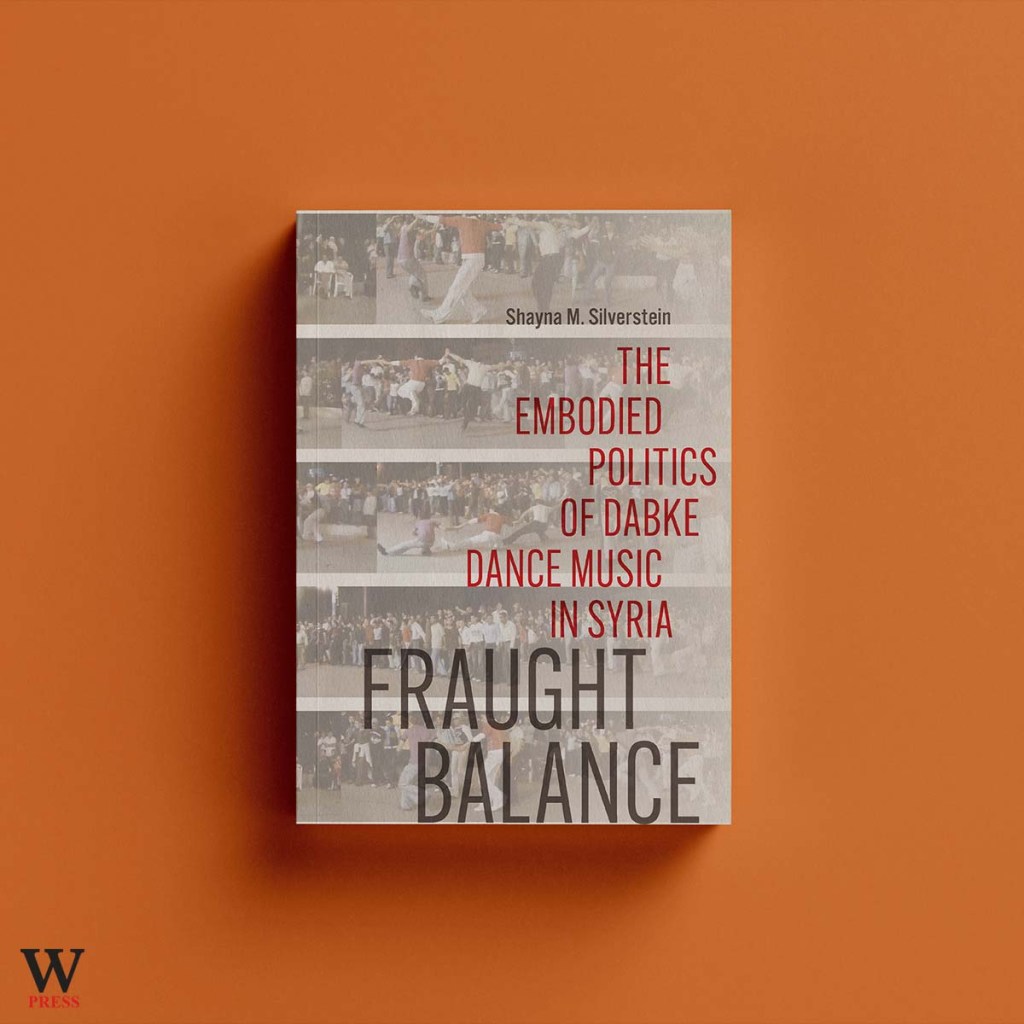
ABOUT FRAUGHT BALANCE
Dabke, one of Syria’s most beloved dance music traditions, is at the center of the country’s war and the social tensions that preceded conflict. Drawing on almost two decades of ethnographic, archival, and digital research, I show how dabke dance music embodies the fraught dynamics of gender, class, ethnicity, and nationhood in an authoritarian state. My book situates dabke politically, economically, and historically in a broader account of expressive culture in Syria’s recent (and ongoing) turmoil. I show how people imagine the Syrian nation through dabke, how the state has coopted it, how performances of masculinity reveal—and play with—the tensions and complexities of the broader social imaginary, how forces opposed to the state have used it resistively, and how migrants and refugees have reimagined it in their new homes in Europe and the United States. I offer deeply thoughtful reflections on the ethnographer’s ethical and political dilemmas on fieldwork in an authoritarian state. My study ultimately questions the limits of authoritarian power, considering the pleasure and play intrinsic to dabke circles as evidence for how performance cultures sustain social life and solidify group bonds while reproducing the societal divides endemic to Syrian authoritarianism.
Published by Wesleyan University Press Music/Culture series Publication date May 7, 2024
Curious to hear more about the book? Check out my podcast interviews with New Books Networks and Borderlines!
Interested in reading or teaching the book? Want to know more about how it is organized and where to find companion media? Click the “Companion Booksite” button below or jump here to find answers to these questions and more.
Want to learn how to dabke? Learn more about my “Dabke Stories” workshop! This is a facilitated participatory session for first-timers to skilled dancers that unlocks the connection between our bodies, narrative, and dabke technique.
 Shayna M. Silverstein